For a unit price comparison, divide the price of an option by its total quantity, then compare both options using the same measure and currency. A lower price per ounce, gram or item does not automatically mean a lower checkout total or a better purchase for your household.
Use the calculator below for two comparable products. It separates the number of packs from the quantity in each pack and shows the upfront price beside the unit price. No retailer prices are fetched. The worked figures are invented arithmetic examples, not current offers.
Compare two options on one basis
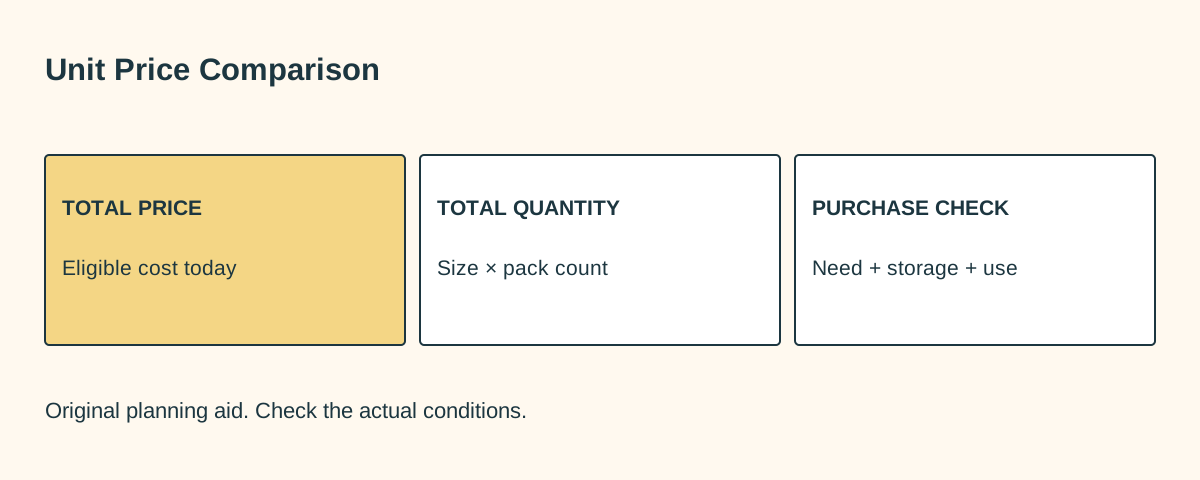
Select a shared unit, such as grams, fluid ounces or individual items. Enter the total price of each option, the quantity in one pack and the number of packs included at that price. For a single package, use a pack count of one.
If a shelf label already gives a unit price, check its measure before comparing it with another label. Grams and kilograms can be converted onto one basis; weight ounces and fluid ounces describe different quantities. The calculator does not perform conversions or make unlike products equivalent.
The NIST unit-pricing resource describes unit pricing as cost per measure and explains its use for comparing product quantities. Our calculator is an original shopping aid, not a certification of a retailer's labels or a statement about the law in every state.
Same-unit price calculator
The prefilled numbers are an invented example. Use one currency and unit for both options.
Enter comparable prices and quantities, then compare.
No conversions, price fetching or entry storage. Delivery and other charges are excluded unless you included them consistently.
Work through a multipack example
Suppose option A costs USD 6 for two packs of 250 g each. Its total quantity is 500 g, so the price is USD 0.012 per gram, or USD 1.20 per 100 g. Option B costs USD 8.40 for one 750 g pack. That is USD 0.0112 per gram, or USD 1.12 per 100 g.
| Illustrative option | Upfront price | Total quantity | Price per 100 g |
|---|---|---|---|
| A: two 250 g packs | USD 6.00 | 500 g | USD 1.20 |
| B: one 750 g pack | USD 8.40 | 750 g | USD 1.12 |
B has the lower unit price but needs USD 2.40 more at checkout. It also supplies 250 g more product. Whether that is useful depends on what you need and can use. These amounts exclude delivery, tax and other charges unless you have already included a comparable allocation in both entered prices.
Check what the entered price actually buys
A price attached to one pack should not be divided by the contents of three packs. Equally, a three-pack offer needs all three packs included in the quantity. Check whether a discount depends on membership, a subscription, a particular payment method or buying several eligible items.
Enter a discount only when you qualify for it and can verify the resulting price. Do not count future points or a possible rebate as an immediate reduction without deciding how to treat it consistently. If a basket-wide discount cannot fairly be assigned to the two products, compare the whole basket separately.
Use the blank unit-price comparison record to save the product description, source date, pack size, conditions and unresolved costs. The download is separate from the calculator; the page does not upload or store your entries.
Decide whether the products are comparable
Price per gram compares quantity, not ingredient strength, performance, nutrition or suitability. Two cleaning concentrates with different label instructions cannot be compared by bottle volume alone. Do not change a dilution instruction to make a cheaper-looking result.
For refill decisions, read our refill-pouch comparison. For cleaning products, use the label-led concentrate comparison. Those pages address product use; this calculator handles the arithmetic once you have chosen a comparable quantity.
Add a household stop check
Before choosing the lower unit price, check the money needed today, usable storage, expiry or deterioration risk and whether you wanted the larger quantity before seeing the offer. If you would discard part of a large pack, a calculation based on the full contents can overstate its practical value.
If both unit prices are equal, the arithmetic has not identified a winner. Choose using the actual quantity needed, checkout cost and other relevant product conditions. Small differences shown after rounding also deserve a second look at the inputs rather than a confident savings claim.
Sources checked 15 October 2026. This tool compares your entered assumptions. It does not verify live offers, product equivalence or future savings.