Illustrative real shopping photograph; it does not show an actual customer refund or either fictional offer.
Before accepting store credit, compare what you can actually use with the refund option available for your purchase. Check the amount, restrictions and deadline in writing. A credit with the same face value as a refund may require another purchase, leave money unused or apply only to selected items.
This is a decision worksheet, not a statement of your legal entitlement. Rights and return policies depend on the purchase and jurisdiction.
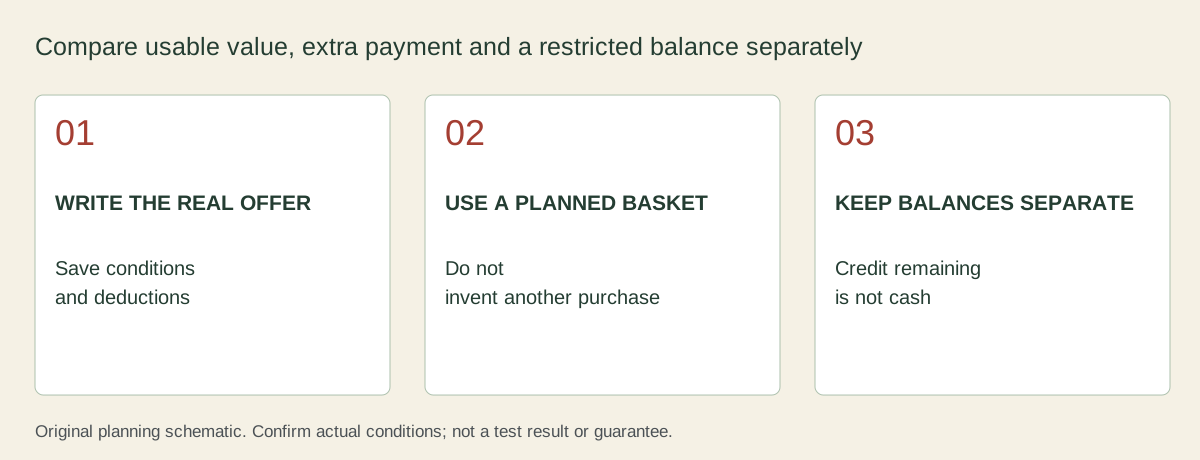
Establish the offer first
Find the order confirmation, receipt and relevant return policy. Check whether the seller is offering a refund to the original payment method, store credit, an exchange or a choice. Confirm any deductions and the conditions for sending the item back.
Do not rely on a policy from a different country, marketplace seller or purchase date. If the item is faulty or the offer seems inconsistent with applicable rights, seek the appropriate local consumer guidance before accepting a settlement.
The FTC's guide to resolving problems with businesses is a useful U.S. starting point for checking policies, keeping records and contacting a business. It does not establish that every buyer can choose a cash refund.
The everyday shopping guides provide related purchase checks; compare this credit against a purchase you actually intend to make.
Compare usable value
| Question | Refund option | Store-credit option |
|---|---|---|
| Amount received | Amount after any stated deductions | Credit amount and currency |
| Timing | Seller's stated processing route and timeframe | When the credit becomes usable |
| Restrictions | Conditions of the refund offer | Eligible items, channels and accounts |
| Deadline | Return or acceptance deadline | Any stated expiry or other time limit |
| Extra spending | Return costs if applicable | Shipping, minimum order or an added purchase |
| Leftover amount | Not usually a shopping balance | Whether a remaining balance can be used later |
Ask the seller about unknown entries. Do not record “no restrictions” merely because the email does not mention them.
Use a purchase you already intended to make
Suppose a hypothetical offer is $40 refunded or $45 in credit. If an eligible item you already planned to buy costs $38, check whether the remaining $7 stays available and whether shipping adds a cost. If the credit pushes you toward a $70 purchase you did not need, its higher face value alone is not a reason to accept it.
Use the actual offer and current basket to make the comparison. Do not assume a coupon, sale price or loyalty benefit can be combined with credit. Confirm the terms for that order rather than applying a rule from another retailer.
Check what accepting means
Before selecting an option, read the acceptance wording and save a copy of the relevant terms. If the effect on an ongoing complaint or another remedy is unclear, ask for clarification or appropriate advice. This article cannot determine that effect for you.
Keep the return tracking, offer, acceptance and confirmation together. Avoid sending full payment details in ordinary support messages.
## Compare the actual return offers on one sheet
A cash refund and store credit are comparable only after deductions, conditions and intended spending are recorded. The table describes possible offers; it does not say a seller may legally impose every condition. A disputed restriction needs the applicable consumer-advice route.
| Written offer | Record before accepting | Decision question |
|---|---|---|
| Refund to original payment method | Actual amount after any disputed or agreed deduction, expected processing steps | Do you need to buy anything else to receive this amount? |
| Credit with no additional incentive | Eligible goods, remaining balance rules, transferability and any stated deadline | Is there already a suitable planned purchase? |
| Larger credit instead of a smaller refund | Same fields plus additional spend and delivery costs | Does the usable extra value justify the restrictions for you? |
| Exchange only or final-sale claim | Exact policy version, reason for return and the seller's written response | Is this consistent with the purchase and applicable rights? |
Keep the gross face value, amount you expect to use and unspent remainder separate. Do not apply a coupon until the order's terms confirm that it combines with credit. A return of the replacement item may produce credit again; ask rather than assume it produces cash.
Hypothetical example: a larger credit can leave less useful value
Suppose the written options are an $80 refund or $90 credit. You already intend to buy one eligible $70 item. In this invented example, delivery costs $6, credit can pay for the item only and you expect no other purchase before its stated use-by date.
| Option | What you can use for the planned item | Other payment | Remainder |
|---|---|---|---|
| $80 refund | $70 cash for the item | $6 delivery from the refund | $4 cash remains |
| $90 credit | $70 applied to the item | $6 paid separately | $20 restricted credit remains |
The $20 is not automatically a $20 loss: it remains usable only if another eligible purchase actually fits the terms. If it expires unused under the assumed offer, realised credit use was $70, not $90. Compared with the refund route, you also paid delivery separately. This example is not a claim that such expiry is lawful in every jurisdiction.
Hypothetical example: a planned basket can change the result
Now suppose a different written offer gives an $80 refund or $90 credit, and you independently planned a $100 eligible purchase. Delivery is free on that basket and credit is accepted for the whole item amount. Refund plus $20 buys it; credit plus $10 buys it. Under those assumptions, credit reduces the additional cash needed by $10.
Do not create the $100 purchase merely to make the arithmetic look favourable. If the item price, delivery threshold, expiry rule or stacking restriction changes, recompute the comparison. No probability of future redemption is invented here: record the intended purchase and unresolved conditions instead.
## Make the decision from the record
A refund may be more useful when you do not want another purchase. Credit may suit a planned eligible purchase when its conditions work for you. Neither conclusion follows from the larger headline amount alone.
Your decision note can be one sentence: “I chose this option because its usable amount, conditions and timing fit my situation.” If you cannot finish that sentence without guessing at a key condition, ask the seller before accepting.
For a future sale purchase, checking fabric, care and return costs before buying can make the terms easier to compare in advance. For a planned replacement, bedding material, care and return checks keep the item choice separate from the incentive to spend a credit.
Download the editable return-offer comparison record. It contains the two explicitly fictional examples and a blank row for your written offer; it does not retrieve retailer policies or calculate legal entitlements.